JFW interviewed in The Seattle Times
Sandi Doughton, science reporter for The Seattle Times, has a story in the paper today, “Sale of elephant-tusk stockpiles may encourage poaching, experts worry.” I was interviewed for the piece, which appears one day in advance of the opening of the CITES meeting in Doha, Qatar, at which Tanzania and Zambia’s proposals to sell their ivory stockpiles will be hotly debated. Doughton writes, “Walker argues ivory sales in countries where elephant populations are healthy may be the best way to ensure the species’ survival. ‘You do not have to kill elephants to get their ivory,’ he said. ‘Elephants die … and they leave behind these gleaming tusks.'”
The story could not be more timely. Read the entire article here.
JFW interview on Safaritalk
Matthew Wilkinson, who runs the website Safaritalk from his base in Portugal, interviewed me at length on ivory issues (click here for the complete interview). The site has a number of forums and blogs where people who share a passion for African wildlife conservation can engage in discussions with people in the field and find out about worthwhile projects—and how to support them.
Ivory’s Ghosts now available in paperback and ebook editions
Grove Press has released a reprint edition of Ivory’s Ghosts: The White Gold of History and the Fate of Elephants (320 pages, $15. ISBN-13: 978-0802144522). (“Praised for the nuance and sensitivity with which it approaches one of the most fraught conservation issues we face today, John Frederick Walker’s Ivory’s Ghosts tells the astonishing story of the power of ivory through the ages, and its impact on elephants.”)
Ebook editions are also available for Kindle, Sony, Barnes and Noble Nook and other readers.
Did Humans Kill Off the Mammoth?

Were spear-carrying ice age hunters responsible for the disappearance of woolly mammoths, ground sloths, and other large, lumbering animals of the Pleistocene? No theories that seek to explain their demise—even ones that invoke crashing comets and climate change—seize the public’s attention the way this “blitzkrieg” hypothesis does. The idea that early humans went on a millennia-long killing spree gives us the shivers and confirms our worst fears about ourselves. See, the thinking goes, humans have been mucking up the planet since we stood upright….
That our species contributes to global warming is inarguable, but there’s been less certainty over whether we had a role in ice age extinctions. That question has returned with renewed urgency with the recent publication of “Pleistocene megafaunal collapse” in Science by Jacquelyn Gill, John W. Williams and researchers at the University of Wisconsin-Madison and other institutions. It sparked a flurry of media reports.
The team studied the dung fungus in lake deposits at sites in Indiana and New York left behind by mammoths and their ilk. These humble markers suggest that the giant beasts that once roamed North America began dying out between 14,800 and 13,700 years ago. That was before the shift in vegetation from grasslands to forest that some theorists argued was the reason for these creatures’ decline. Now it looks like their disappearance caused the changeover in habitat greenery and the increased wildfires that followed. If this timeline is accurate, another great critter die-off theory also collapses: a comet impact on (or over) what became Canada around 12,900 years ago. Ditto for the supposed killer cold-snap of the Younger Dryas, the return to semi-ice age conditions that some say may have been triggered by the impact.
So let’s take a close look at those spear-shaking humans.
The blitzkrieg hypothesis is associated with Paul Martin of the University of Arizona, who, starting in the 1960s, underscored the association between megafauna die-offs and the spread of the human species. Butchered mammoth bones from the period 14,700 to 14,100 years ago found at a site in Wisconsin suggests that people were hunting these huge creatures at the very start of their decline. And a mammoth skeleton with a spear point in its ribs was among the first evidence found of the Clovis People, so named after the artifacts (notably elegant and deadly spear points) of a late Paleolithic hunting and foraging culture uncovered near Clovis, New Mexico. Those people are thought to have crossed from Siberia to Alaska during lowered sea-levels of the last ice age before fanning out across the continent about 13,000 years ago, when megafaunal extinctions were largely finishing up, and may well have helped hasten the process.
Although humans are omnivorous and can make use of a wide variety of nutritional sources, the concentrated food value of meat in this period made hunting a key survival strategy. Killing small game, which requires a large expenditure of energy for a relatively small gain, could not match the payoff of bringing down larger prey. Pleistocene peoples became efficient killers, learning to isolate, trap, and throw spears at their prey before finishing the job at close quarters.
Did they hunt to extinction many of the creatures they encountered? We have the grim examples of man-driven massacres of island species, notably on Madagascar and New Zealand. In historic times, we have the evidence of the annihilation of the quagga, the dodo, the thylacine, the passenger pigeon, et al.—surely we could have snuffed out whole species back in the days when no one was keeping a list.
But some researchers find the overkill hypothesis distinctly overrated. Paleontologist Ross MacPhee has pointed out that there are a number of examples of species, including fur seals, various whales, and bison that weren’t wiped out despite ruthless pursuit by later humans with highly advanced weaponry.
It’s been suggested that now-extinct megafauna were doomed by their lack of wariness and their inability to cope with the sudden appearance of two-legged predators streaming into their habitat. The cow-sized ground sloth of the late Pleistocene was probably slow-witted and relatively easy to bag. But were woolly mammoths really so naïve that they allowed human hunters to sidle up to them and plunge a stone-tipped spear between their ribs? Wouldn’t they have been leery of approaching humans? If not at first, how long would it have taken the ancestors of modern elephants to develop strategies to deal with these strange new enemies?
Even if it was relatively easy pickings for these hunters—a big if—did they knock off more than they could eat, just for the hell of it, the way 19th century train passengers used to amuse themselves by shooting bison from railway car windows on the Kansas Pacific? In the harsh Pleistocene, excess slaughter would have been a waste of precious energy, and pointlessly courting injury or death when larger quarry was tackled. Although various parts—skin, bones, teeth—of the animals slain were utilized, and mammoth ivory in particular prized as a carving material, we can be confident that meat was the main point of a hunt in pre-history.
It would have taken more than intermittent wanton slaughter for the tiny populations of early man to kill off slow-breeding species faster than they could replace themselves, sending them into an irreversible slide. It’s possible a few animals disappeared this way, but what about all other extinct species in North America, like bear-sized beavers and western camels? Humans would have had to methodically exterminate millions of such creatures, chasing them down in every corner of the continent. To explain the global disappearance of megafauna, this unlikely scenario would have to have been repeated on every other continent as well.
MacPhee concedes that the evidence shows that wherever humans arrived, animal extinctions followed, but doubts that hunting alone explains that. In collaboration with Preston Marx, MacPhee hypothesized that humans may have brought diseases with them that killed off indigenous species, although so far no evidence for the hyperdisease model has been uncovered.
Gill said that while her group’s new findings weren’t consistent with the blitzkrieg hypothesis, she and her colleagues couldn’t flatly rule out human involvement. For other researchers, the idea that Pleistocene hunters singlehandedly knocked off the mammoth and similar megafauna may just be too seductive to let go. Christopher Johnson, an Australian biologist who wrote an accompanying commentary in the same issue of Science, remains convinced that human hunters were the “sole cause” of “megafaunal extinction.”
Next month’s meeting in San Francisco of the American Geophysical Union will give comet proponents a chance to present new evidence for their extinction-with-a-bang theory. Frankly, it may take the impact of a comet to make those who blame our ancestors for the disappearance of the mammoth to drop the idea.
Selling Ivory to Save the Elephants
I wrote an Op-Ed that appeared in The Washington Post on October 17, 2009—the 20th anniversary of the ivory ban vote that brought the ancient international trade in ivory to a halt—to ask why the ban wasn’t more effective. It’s reprinted below:
Selling Ivory to Save the Elephants
By John Frederick Walker
Ivory poaching is back, big time, and the Internet is awash with photos of bloodied tusks and elephant carcasses.
In 2007, Kenyan wildlife officials counted 47 elephants killed by poachers. In 2008, the number jumped to 98. Estimates of the number of elephants now being poached across the African continent range as high as 37,000 a year. All this despite a ban on international trade in ivory that was enacted 20 years ago today.
Why hasn’t the ivory ban been effective? Mostly because it doesn’t fit the reality of the situation.
In 1989, anti-ivory campaigners were riding a wave of worldwide revulsion at poaching that had halved the African elephant population over the previous decade. They took their cause to CITES (the Convention on International Trade in Endangered Species of Wild Fauna and Flora), the U.N.-administered convention that governs trade in endangered species. At the 1989 Conference of Parties in Lausanne, Switzerland, member countries ended more than a week of heated debate on Oct. 17. On a vote of 76 for, 11 against, and four abstentions, the African elephant was put on the list of species considered threatened with extinction. Inclusion prohibits all cross-border trade.
But there was a catch: Countries with well-managed populations could apply to CITES to have the status of their elephants declared to be less threatened. If they proved their case, they might be allowed to resume trade in ivory. Still, global trade in tusks had been banned, putting an end to the commerce that had been the curse of elephants for millennia.
In the aftermath, elephant poaching in Africa declined. But then it grimly started climbing back, and today it is at disturbing levels, as recent seizures of huge amounts of poached ivory make clear.
Some conservationists say the problem with the ban has been lack of enforcement. Many African countries with elephant populations have unregulated domestic markets at which items made from poached ivory can be purchased and then smuggled out of country. There’s little dispute that better policing is desperately needed.
Other advocates point to CITES-permitted legal ivory sales as the ban’s major flaw. These sales have been authorized twice — most recently in late 2008, when Namibia, Botswana, Zimbabwe and South Africa were allowed to auction 100 tons of ivory collected from elephants that had died of natural causes. Those tusks went to Japan and China, which agreed not to re-export any ivory, and the $15 million raised went toward elephant conservation.
Ivory trade opponents — including Kenya — have long argued that legitimizing any trade in ivory, no matter how tightly controlled, sends the wrong message to poaching rings and feeds the demand for ivory. But TRAFFIC, the joint World Wildlife Fund/International Union for Conservation of Nature wildlife trade monitoring network, says there’s no hard evidence that these sales lead to more poaching or increased illegal trade in ivory.
Enforcement issues and potential ivory sales are sure to dominate the CITES conference in Doha, Qatar, in March, at which Tanzania, Zambia and Mozambique are expected to submit proposals to sell their ivory stockpiles — and set off alarmist media coverage.
But what’s happening to elephants and their ivory is far more complex than the picture painted by most news organizations, which focus almost exclusively on elephant killings, giving the impression that these great creatures are being killed all over the continent.
The truth is that ivory poaching is most widespread in African states saddled with civil wars and racked by humanitarian crises, riddled by corruption and lacking effective conservation — of which Congo is an all-too-ghastly example. By contrast, elephant numbers are increasing in the stable countries of southern Africa, where anti-poaching efforts have had some effect. Botswana has 130,000 elephants, nearly a quarter of the entire continental population. In South Africa’s Kruger National Park, officials have concluded they will have to turn to culling to keep their growing herds from altering the landscape of the New Jersey-sized refuge.
Add in another inescapable fact: Tens of tons of gleaming tusks are recovered annually from elephants that die of natural causes in Africa’s parks and reserves. Not surprisingly, countries that are doing a good job of managing their elephant populations argue that they should be able to benefit from the sale of guilt-free tusks to raise badly needed funds for the conservation of their giants.
That’s what the procedure for seeking an exemption to the ban and gaining permission to sell ivory stocks was supposed to address. The problem is that the possibility of these sales is revisited at every CITES conference, which means that legal buyers (currently, ivory traders and merchants in China and Japan) can never be certain of future supply. That keeps the black market alive, preventing legal ivory from undercutting illicit supplies and crippling organized poaching. It’s estimated that 100 tons of ivory could be supplied each year from the natural mortality of Africa’s elephants, an amount likely to meet Asian demand for this long-revered carving material. A tightly controlled but steady stream of legal ivory from countries with protected herds, coupled with strict policing of domestic African ivory markets, may sound like an unholy coupling of conservation policies — but it just might work.
Through almost all of human history elephants have been regarded as mere bearers of treasure; now we find them far more important than the ivory they carry. That’s why the ivory ban came into being 20 years ago, and why the international community will never return to a completely unregulated ivory trade. But if the ban’s limitations aren’t addressed, its provisions strengthened — and new ideas incorporated — we’ll end up facing another 20 years of poaching, ivory trafficking and elephant killings.
John Frederick Walker is the author of “Ivory’s Ghosts: The White Gold of History and the Fate of Elephants.”
20 Years and Counting: Why the Ivory Debate Won’t Go Away
Twenty years ago tomorrow, Kenya’s president Daniel arap Moi lit a bonfire of 2,000 elephant tusks in Nairobi National Park as a dramatic gesture to signal his country’s stance against the trade in illegal ivory. Photographs of the huge blaze, with its black smoke curling skyward, appeared around the world and the event came to symbolize global revulsion against ivory poaching—and the killings that halved the African continent’s elephant population in single decade.
A few months later, in October of 1989, member countries at a CITES meeting in Lausanne, Switzerland decided to halt international trade in ivory. The ban came into effect at the beginning of 1990.
But it’s not easy to get rid of ivory—in fact, it took 60 tons of firewood and forty gallons of gasoline to ignite Moi’s twenty-foot stack of tusks. And it’s impossible to eliminate all trade in ivory—because bad as the illegal trade in ivory is for elephants, legitimate, regulated trade in ivory can actually help them.
How? Ivory is something elephants leave behind when they die of natural causes, and tons of it is routinely stockpiled by African nations. Those countries that do a good job of managing their elephant populations (as evidenced by their growing herds) have twice successfully petitioned CITES to allow “one-off” sales of their legitimate ivory stockpiles to raise money for elephant conservation.
The most recent sale, in October of last year, raised some $15 million dollars for South Africa, Namibia, Botswana and Zimbabwe. As part of the deal, these four nations were prohibited from petitioning CITES to sell additional ivory for nine years.
Much of the media misunderstood this critical detail, and asserted that all trade in ivory had been halted for another nine years. However, African countries that were not part of this “one-off” sale aren’t restricted from submitting proposals to sell their ivory stocks. Sources tell me CITES expects to hear from Tanzania, Zambia and Mozambique at its next meeting in March, 2010.
The role of ivory in elephant conservation is a contentious issue, and will likely remain one for years to come. But in a shrinking world, elephants can’t wait forever for solutions. Ways must be found to suppress illegal elephant killings that feed the black market in ivory. At the same time, steps have to be taken to allow limited, highly controlled exports of legitimate ivory from countries that deserve to benefit from their successful efforts at protecting their elephants.
JFW’s Ivory’s Ghosts Harvard Lecture on WGBH
My well-attended lecture at the Harvard Museum of Natural History this past January was recorded by WGBH in Boston, and is now on their website as part of their Forum Network.
 The Kilimanjaro Tusks, 1898
The presentation includes a series of images of ivory art, the African commerce in tusks, and of course elephants, and touches on as many of the book’s themes as can be squeezed into an hour. A Q&A segment follows. Click here to view the lecture.
Oldest Prehistoric Ivory Venus Figure
In Ivory’s Ghosts, I described how archaeologists at the University of Tübingen found the oldest known carving in a cave in SW Germany in 2007—a mottled, inch-high 35,000 year-old figure of a mammoth, shaped from that species’ ivory. The mammoth, of course, is the ancestor of the modern elephant.
Today it was announced that a nearby cave held another surprise: a small ivory carving of a woman of similar antiquity, which would make it the oldest of the so-called “Venus” figures, those famously bulbous Ice Age female forms. Many were amulets, likely worn around the neck, and held close to the flesh. The especially fleshy example uncovered, with its enormous breasts and exaggerated genitals, is a striking example, and from a period not previously known for human female imagery.
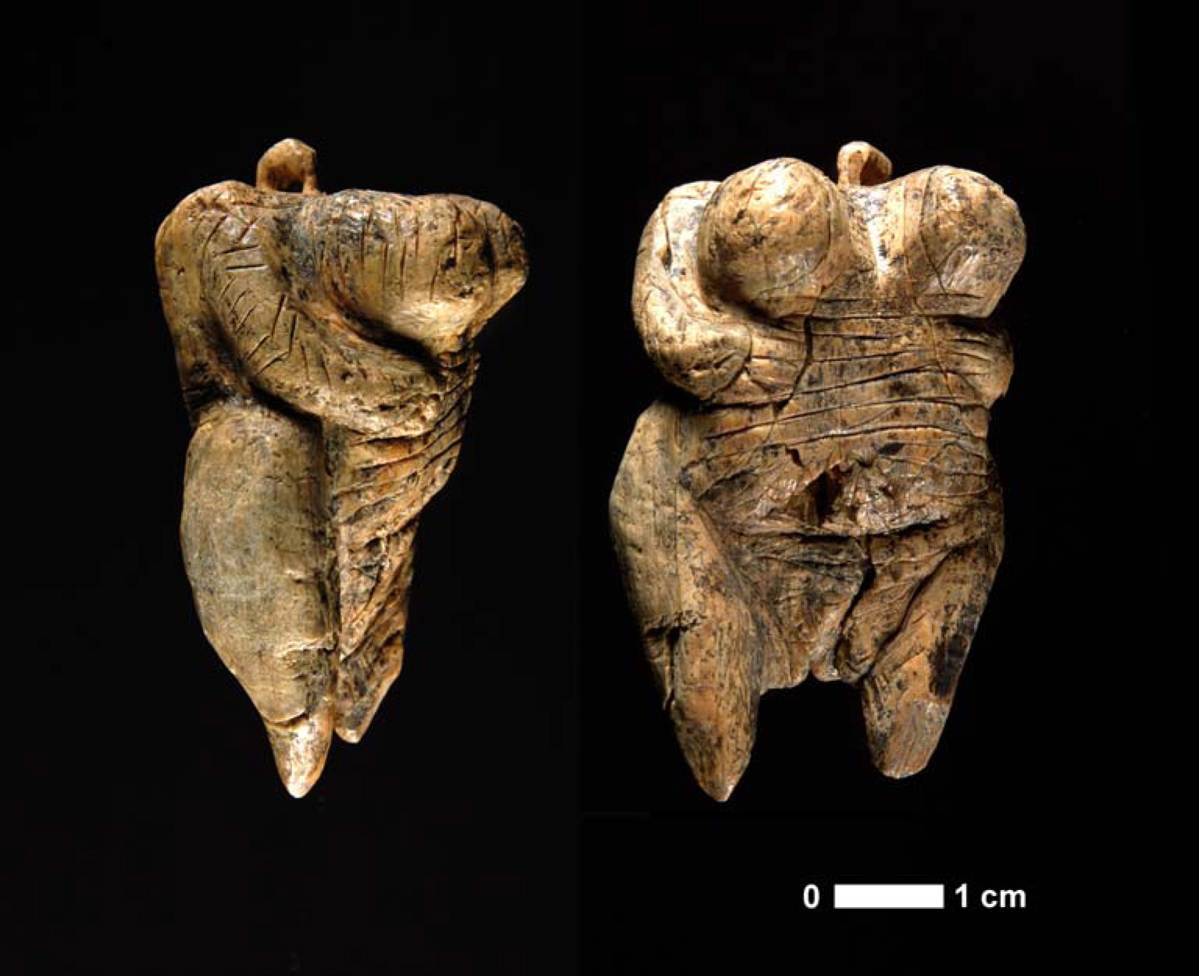
The Venus of Hohle Fels. Foto: H. Jensen. Copyright: Universität Tübingen
Were these “Venus” figures magical objects, teaching tools, sex toys or….? I discuss some of the possibilities in the book, and concede that we may never know what they meant to early humans. But we do know, as I explain, quite a bit about the importance of ivory in prehistory. Mammoths weren’t hunted for their ivory—it was a by-product of the never-ending hunt for food.
But it didn’t take long to discover ivory was an amazing material for sculpture. It’s not as hard as rock, doesn’t split like bone or wood; it has no discernable grain but a perfectly latticed cellular structure, allowing superb detail to be carved, and—this helps explain ivory’s allure through the ages—a wondrous, silky, milky surface when polished that’s very seductive to the eye and the touch.
Ivory’s Ghosts reviewed in Audubon magazine
The May-June issue of Audubon magazine includes Ivory’s Ghosts in its “Editors’ Choice” section, with a review by Alexa Schirtzinger. She writes “With elephants, Walker explains over the course of his carefully wrought book, the classic collision between human life and wildlife has a unique dimension: the ancient and quasi-mystical relationship between people and ivory.” Read the complete review here (scroll down the page).
 John Frederick Walker
leave a comment